Why we wrote our own AI readiness framework
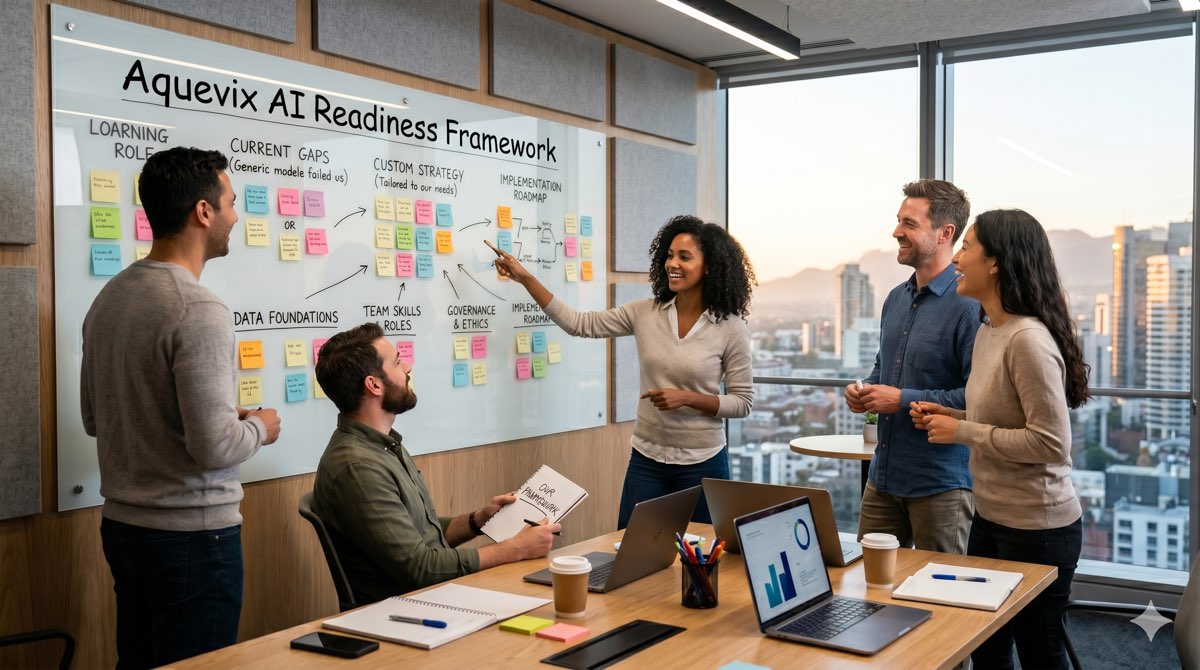
Why we wrote our own AI readiness framework
Every major global consultancy has an AI readiness framework. Microsoft has one. Gartner has one. McKinsey, Accenture, Deloitte. Some are genuinely thoughtful. All are built for a factory that does not look like yours.
I spent most of 2024 sitting with Indian SME manufacturers in Panipat, RAI, Kundli and Delhi. Textiles, engineering, auto components, food processing. Revenues from ₹50 crore to ₹500 crore. By any global measure, these are serious businesses. By any global AI framework’s measure, they do not exist.
Here is what the frameworks assume:
- A dedicated IT team with a director-level sponsor.
- An ERP already running, cleanly.
- Data governance already in place.
- An annual technology budget measured in percent of revenue, not lakhs.
- Employees who work in English, on laptops, during one shift.
Here is what I kept seeing:
- An owner in his sixties who still signs every cheque.
- A next-generation son or daughter, recently back from an MBA, trying to modernise without offending dad.
- Tally as the accounting backbone. Excel as the operations layer. WhatsApp as the workplace.
- A total IT spend of ₹5 to ₹50 lakh a year, almost none of it planned.
- Operators who work in Hindi or Punjabi on shared Android phones. Two shifts. Six days.
- A data room that consists of paper registers, a few PDFs, and a laptop under the stockroom table.
None of this is broken. A lot of it is beautiful in its own way. It is simply not what any framework written in San Francisco or Redmond had in mind. When a ₹50 Cr Indian manufacturer tries to apply, say, the Microsoft AI Transformation Framework, the first step is “establish an AI Center of Excellence.” That is a conversation nobody on that shop floor has time for.
The moment we decided
We were in a factory near Sonipat with an owner I have known for years. He had read an AI whitepaper, asked his son to brief him, and then asked me: “Amit, what is step one?” I pulled out the Accenture framework I had brought along to walk through. He read three pages and slid it back across the table.
“This is not for us,” he said. “This is for someone whose problems are already solved.”
He was right. Every one of those global frameworks starts by assuming the Indian factory’s hardest problems are finished. Our hardest problems are the ones those frameworks skip.
So we wrote our own.
What FORGE is and is not
FORGE is Factory Operations Readiness for Generative Excellence. It is a seven-phase framework that takes a ₹50 to 500 crore Indian manufacturer from a Tally + Excel + WhatsApp stack to AI-native operations over twenty-four months.
The seven phases, in one line each:
- SCOUT · Weeks 1 to 4. Free readiness assessment, baseline KPIs, three shortlisted quick wins.
- STRUCTURE · Months 2 to 4. Deploy or upgrade ERP, digitise paper records, master data standards.
- SPARK · Months 4 to 8. GST automation, WhatsApp AI chatbot, payroll automation. Two to three quick wins.
- SCALE · Months 8 to 14. IoT on critical machines, computer vision quality, demand forecasting.
- SYNC · Months 14 to 18. Break the silos. Unified CXO dashboard. Compliance calendar.
- STRENGTHEN · Months 18 to 22. Internal AI governance, ZED certification, DPDP readiness.
- SUSTAIN · Months 22 to 24+. Autonomous agents. Digital twin. New business models.
FORGE is not a slide deck. It is not a transformation theory. It is the sequence we have watched work on real shop floors. Each phase has a budget range, a set of named roles, a checklist to close it out, and deliverables you can hand to your auditor.
Three principles we locked in
- Start where the factory is. No phase assumes a data lake, an AI team, or an MBA in operations. Phase 2 assumes a Tally-and-paper starting point because that is the starting point.
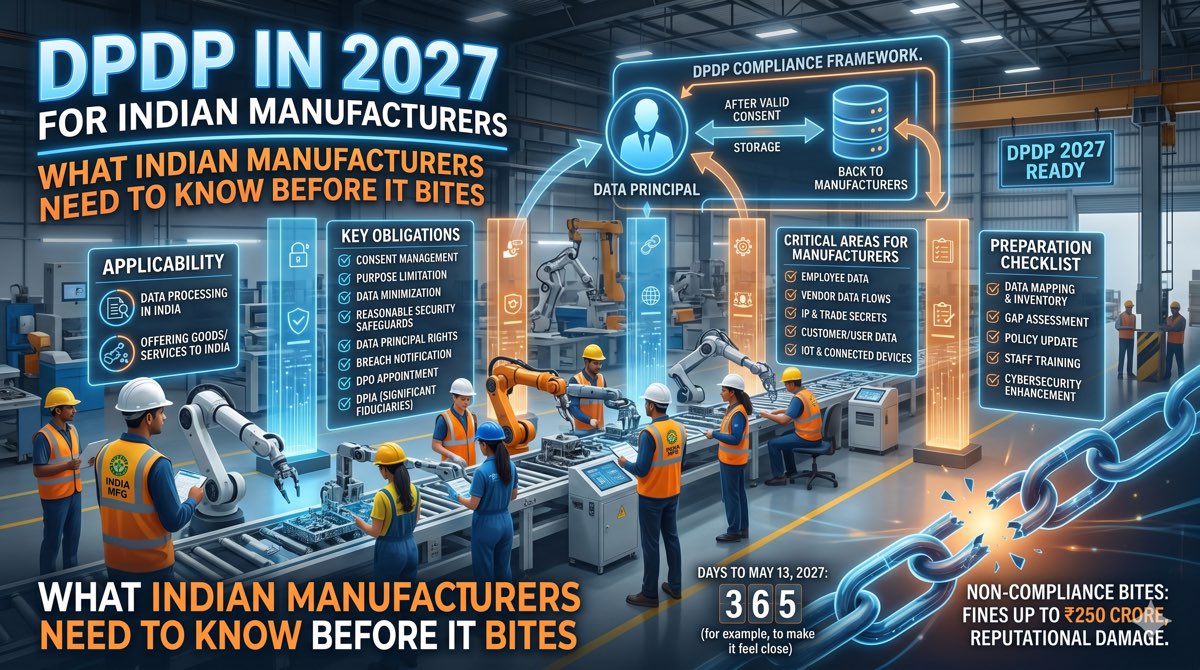
- Subsidies first, invoices second. Most Indian manufacturers have no idea they are eligible for CLCSS (15% capex reimbursement), ZED certification (up to 80% of assessment costs reimbursed) or IndiaAI compute credits at ₹65 per hour. FORGE surfaces these on the first call.
- Vernacular by default. The WhatsApp assessment, the operator UI, the training material: all in Hindi, Punjabi or whichever language the team actually speaks. Global frameworks assume English. Ours does not.
Why it is invitation-only
A twenty-four month programme deserves attention. If we took every manufacturer who raised a hand, we would stop being the senior team that personally reviews every scope. So we cap intake at a handful of factories a quarter. It is not scarcity as marketing. It is scarcity as operational necessity.
If any of this sounds like the factory you run, or the factory you are about to inherit, the first step is the readiness score. Five minutes on WhatsApp, and you will know where you actually stand.