Honest about AI: where it earns its keep, where it does not

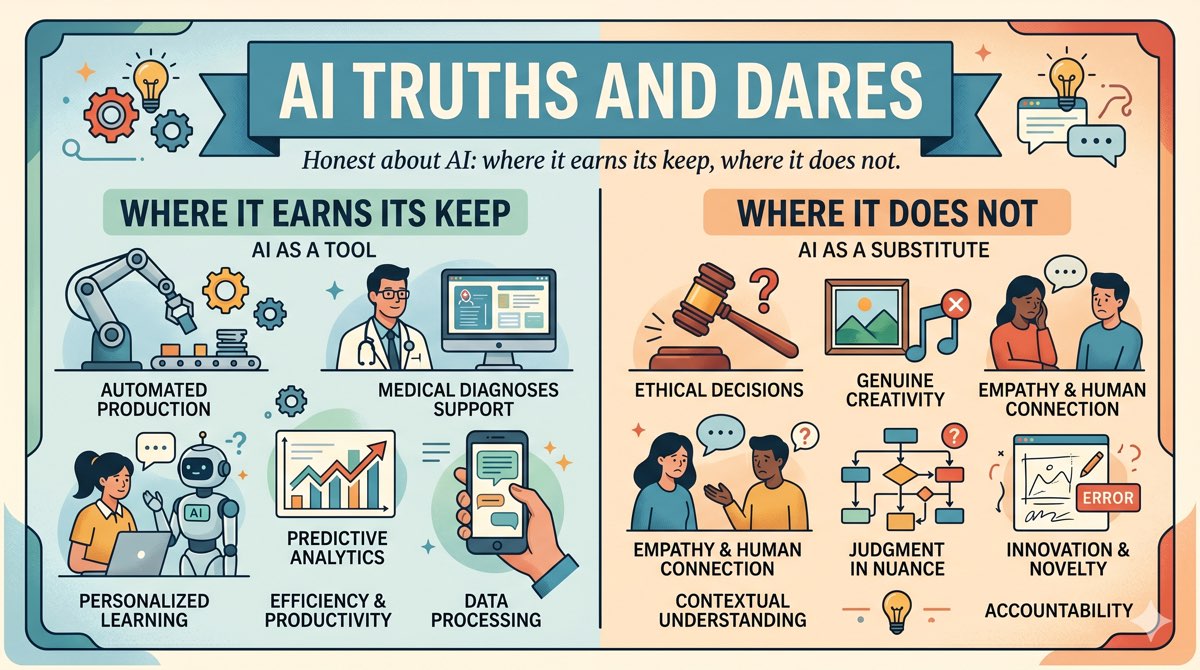
Honest about AI: where it earns its keep, where it does not
Three times last month, an Indian manufacturer showed me a deck some consultant had left on his desk. Each deck promised AI-powered something. Each deck had a ROI number attached. None of the three would have worked.
AI is a tool. It is not a religion and it is not a magic bullet. On an Indian factory floor, AI earns its keep in a surprisingly narrow set of places, and loses money quietly in everywhere else. This post is the plainspoken version of that argument, written for owners who have been shown one too many slide decks.
Where AI earns its keep
Four categories, all of which we have now run in production:
1. Repetitive high-volume decisions that a human can do but gets bored doing.
GST reconciliation is the cleanest example. An accounts clerk can match GSTR-2A to the purchase register. It takes them two to three days a month. By the fifth month of doing it they are making small errors. An AI tool does it in twenty minutes, every month, without fatigue. Honest ROI: 15 to 20 hours saved per month per plant, plus fewer compliance errors.
Similarly: invoice OCR, e-way bill generation, attendance exception flagging, vendor scorecard auto-updates. Each one replaces a tedious human loop with a reliable machine loop.
2. Pattern recognition at a scale humans cannot match.
Computer vision on a production line is the canonical example. Our own Manufacturing Automation flags quantity mismatches and yield leaks in real time, across every process step, across every shift. A supervisor walking the floor could catch maybe 20% of what the software catches. And she has other work.
Predictive maintenance is the other clean example. An IoT sensor reading a motor’s vibration signature knows something is wrong two to four days before it fails. A technician knows it ten minutes before it fails. Which is what we call a breakdown.
3. Natural language interfaces over structured data.
A WhatsApp bot that lets a dispatch clerk ask “what is the stock of yarn batch 4412?” and get an answer from the ERP. The clerk did not have to learn the ERP. The ERP did not have to be rebuilt. The AI is just the translator.
This is the category where Sarvam AI and Bhashini make everything possible in Hindi, Punjabi, Tamil, and most Indian languages. Two years ago this was aspirational. Today it is shipping.
4. Forecasts where the last-N-months pattern is the best available signal.
Demand forecasting for SKUs where seasonality and trend matter. Cash flow forecasting based on receivables and order pipeline. Energy consumption forecasting. In each case, a simple AI model trained on your last twelve months beats the “average of the last three months” rule your finance head has been using.
Where AI quietly loses money
This is the section the deck-selling consultant will not show you.
1. One-off decisions that are high stakes but low frequency.
Who to promote. Which city to open the new plant in. Whether to accept a strategic customer’s pricing demand. Human judgment wins here, not because humans are better pattern-matchers, but because the training set is too small for any machine to generalise from. Anyone selling you AI for strategic decisions is selling you the appearance of rigour.
2. Things where the baseline is already cheap.
If a clerk can do it in five minutes, AI cannot beat her price. The rule of thumb we use: if the manual baseline takes less than thirty minutes per event and costs less than ₹500 per event, AI ROI on that task is probably negative. Automate it only if you are already automating something nearby.
3. Rare-event anomaly detection.
Fraud. Safety incidents. Regulatory violations. These happen rarely enough that the training set will never be big enough. A rule-based system plus a human reviewer will beat a trained model for the first five years. By the time you have enough data to train the model, the rule-based system has solved most of the problem.
4. Unstructured conversations.
An AI agent that answers customer complaints, negotiates with suppliers, or interprets a supervisor’s half-sentence instructions. Current models are impressive in demos. They fail badly in production because the conversation has no ground truth. Use AI to draft the reply. Use a human to send it.
The honest test
Before we recommend AI on any factory floor, we ask four questions:
- Is the baseline manual process slow, repetitive, or error-prone enough to matter?
- Is there enough clean data to train something useful? If yes, where is it? If no, what would it cost to get it clean?
- If the AI is wrong 5% of the time, what breaks?
- What is the alternative? Can we solve 80% of the problem with a rule, a checklist, or a well-placed dashboard?
If the answers make the case, we build. If they do not, we say so and leave. Most of the decks we have been shown fail question 4. The consultant who sold them was pitching AI because AI was their product.
What this means if you are scoping AI for your factory
Three rules:
- Start with the four categories above. Yield leaks, predictive maintenance, language interfaces, forecasts. These pay back.
- Distrust any pitch that starts with “AI-powered” in the headline. Ask what problem the tool solves that your current process does not.
- Do not let a consultant sell you a data lake before you have a clean ERP. FORGE Phase 2 exists for a reason: you cannot put AI on top of paper.
The best AI investment most Indian SME manufacturers could make this year is not an AI investment. It is a data investment. Once the ERP is clean and the master data is in order, the cheap AI wins come quickly. Before that, nothing works.
If you want to see where your factory actually stands, take the FORGE Readiness Score. It is free, five minutes on WhatsApp, and includes an honest read on which of the four categories above would pay back first for your specific operation.
If you are scoping a specific process agent (customer service, internal helpdesk, document intake, compliance), our AI Agents page describes the four-week to six-week build pattern we use.